
How is a pressure vessel made?
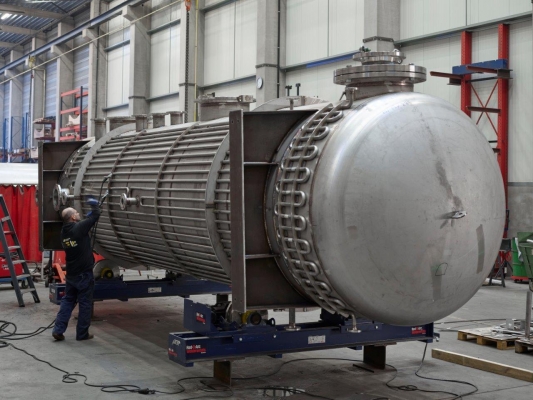
After welding the shells, we prepare the heads, weld the heads to the shells, and weld the nozzles.
Here is where the manual welding begins. Commonly used welding processes for this are TIG and MIG/MAG, including full penetration butt welds, fillet welds, and multiple passes.
High-quality certified welding is, of course, essential.
Nozzles and support legs are often welded with reinforcing pads.
Teamwork is key to ensuring every step is done with precision and care.
The next step is NDT (Non-Destructive Testing).
This typically involves a hydrostatic test, which is often combined with various other testing methods such as PT, RT, MT, UT, TOFD etc, all performed by a NoBo.
These tests ensure the quality and safety of pressure vessels by detecting potential defects without causing damage to the material.
All difficult abbreviations? Let us explain
- Hydrostatic Test: A test where the vessel is filled with water, and pressure is applied to check for leaks and to validate the structural integrity of the vessel.
- Penetrant Testing (PT): This test uses a liquid penetrant applied to the surface to reveal surface-breaking defects. A developer is then applied, which highlights any defects as the penetrant seeps out. The use of red and white colors is common in PT; the red dye indicates the presence of a defect, while the white developer provides a contrasting background to enhance visibility.
- Radiographic Testing (RT): This method uses X-rays or gamma rays to inspect the internal structure of the vessel. It’s effective for detecting internal flaws such as voids, cracks, or inclusions that are not visible on the surface.
- Magnetic Particle Testing (MT): In this test, a magnetic field is applied to the surface of ferromagnetic materials. Iron particles are then sprinkled on the surface, and any surface or near-surface defects will cause a disturbance in the magnetic field, attracting the particles and making the defects visible.
- Ultrasonic Testing (UT) : This test uses high-frequency sound waves that are transmitted into the material. Any internal defects reflect these sound waves, which are then detected and analyzed to determine the location and size of the defects.
- Time of Flight Diffraction (TOFD) : TOFD is an advanced ultrasonic technique that measures the time it takes for sound waves to travel through the material and reflect back from defects. It provides precise information about the size and position of defects within the vessel.
Conducted by a Notified Body (NoBo) : A NoBo is an independent and accredited organization responsible for conducting these tests and ensuring that the pressure vessels meet all safety and quality standards.
These testing methods, performed by a certified NoBo, are critical for ensuring that pressure vessels maintain their integrity and safety throughout their operational life.
In the photo, you can see the traces of PT in the foreground, indicated by the red and white colors, and a hydrostatic test being performed in the background.
Adding internals and/or externals.
Building pressure vessels often involves adding both internals and/or externals. These can include heating elements, cooling elements, spray tubes, coils, but also railings and platforms
Final steps:
The final step in manufacturing pressure vessels is pickling, passivating, and/or post-treatments like coating for steel vessels.
At Deprest, we ensure the surface is fully treated to meet both durability and aesthetic standards.
Pickling and passivating stainless steel involves cleaning the surface, removing impurities, and restoring its protective oxide layer. This crucial in-house process guarantees long-term corrosion resistance and complies with all regulations.
We have a 20x12 meter pickling hall with two overhead cranes for larger projects.
Did you know?
We also offer pickling services for third parties!